


Quechua Textiles: The Meaning Behind Every Andean Design
- 13 de October de 2026
- Parwa Travel
For millions of people around the world, a Quechua textile is simply a craft object with colorful patterns. For those of us who grew up within Andean culture, every thread tells a story — of family, of land, of a worldview. Understanding the meaning of Andean designs completely transforms the experience of visiting Cusco and the Sacred Valley.
This article is an honest, culturally respectful guide to what lies behind every woven piece, so that your trip to Peru goes well beyond surface-level tourism.
Andean Weaving as a Living Language
In the Andean world, weaving has never been a secondary activity. During the Inca Empire — known as the Tawantinsuyu — textile production held the same importance as agriculture or architecture. Fine weavings served as offerings to the gods, diplomatic gifts between nations, and markers of the social rank of those who wore them.
The acllas — chosen women who lived in the acllahuasi — devoted themselves exclusively to weaving the empire’s finest textiles. The unkus (male tunics) and female cloaks communicated, through their patterns, the wearer’s ethnic origin, social hierarchy, and relationship with the forces of the cosmos.
Today, that tradition lives on — not in museums, but in the hands of real communities across the Andes. Visiting Cusco without understanding its textiles is like reading a letter in a language you don’t speak.
The Tocapu: The Visual Code of the Inca Empire
One of the most fascinating elements of Inca textiles is the tocapu: highly standardized geometric designs that appear on ceremonial weavings and also on the ritual wooden cups known as keros. Researchers have proposed that tocapu functioned as a visual communication system — possibly linked to ethnic identities, social ranks, or cosmological narratives — though their full interpretation remains an active area of academic study.
What is clear is that these designs were never randomly decorative. Each combination of geometric shapes carried a precise intention. This visual sophistication is part of what makes Andean textiles unique in the history of pre-Columbian civilizations.
Colors and Their Natural Roots
Before synthetic dyes arrived, Andean textiles were colored exclusively with pigments extracted from plants, minerals, and insects. This tradition of natural dyeing is still practiced by many communities in the Cusco region, and witnessing it firsthand is one of the most memorable experiences of any trip.
- Red and crimson: Derived from cochineal (Dactylopius coccus), an insect that parasitizes prickly pear cacti. Cochineal was one of the most prized commodities of the Viceroyalty of Peru.
- Yellow and orange: From plants such as retama (Spartium junceum) or chinchircuma, found in the high Andean valleys.
- Black and gray: From the Andean walnut tree and certain iron-rich minerals mixed with natural mordants.
- Blue and purple: From indigo and the bark of the q’olle tree (Buddleja coriacea), native to the Andes.
- White and beige: From alpaca and llama fiber in its natural, undyed state.
Understanding the origin of these colors means recognizing that every cloak carries within it the Andean landscape: its mountains, its plants, its animals.
Key Motifs of Quechua Weaving and Their Meaning
Patterns — known as pallay in Quechua — are the visible vocabulary of Andean textiles. Here are some of the most common motifs and their cultural background:
- The chakana (chacana): The twelve-pointed Andean cross, associated with the Southern Cross constellation and the worldview of the three realms: hanan pacha (the upper world), kay pacha (the present world), and ukhu pacha (the inner world). It is one of the oldest and most widespread pre-Columbian symbols on the continent.
- Camelid figures: Llamas and alpacas represent abundance, collective labor, and the deep bond between Andean people and their sacred animals.
- The serpent (amaru): A symbol of transformation, duality, and connection with the ukhu pacha. The two-headed amaru appears in textiles from cultures predating the Inca Empire, including the Wari.
- The condor (kuntur): Messenger of the hanan pacha and symbol of the power that bridges the earthly world with the higher forces of the Andean cosmos.
- Diamonds and zigzags: Associated with water, rivers, and the flow of vital energy. Their arrangement and density vary according to the community and region of origin of the textile.
It is essential to understand that the specific meanings of a textile depend on the community, region, and era. There is no single dictionary of Andean textiles: interpretation should always be approached with respect and, whenever possible, guided by the weavers themselves.
The Technique: The Backstrap Loom
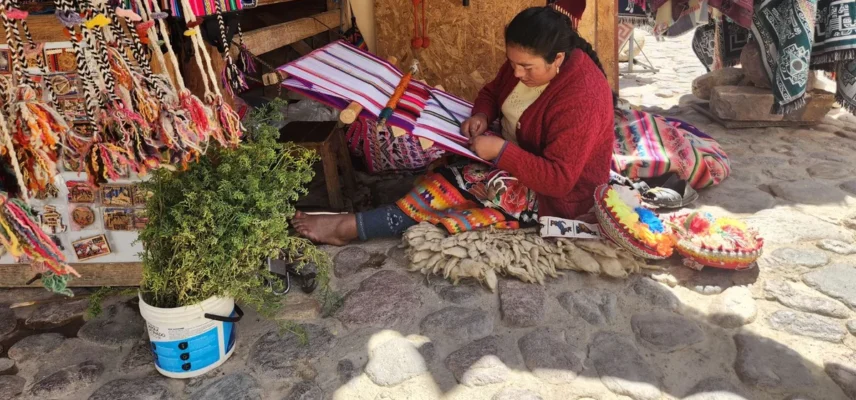
The central tool of Andean weaving is the backstrap loom (also known as the back-tension loom), a technology thousands of years old that requires no fixed structure. The weaver anchors one end of the loom to a tree or post and the other to her own body, using physical tension to control every aspect of the weave.
This technique allows for extraordinarily high thread counts. Pre-Hispanic Andean textiles — particularly those of the Paracas and Wari cultures — rank among the finest ever documented in the history of ancient civilizations. The treadle loom — introduced during the colonial period — and other formats also exist, but the backstrap loom remains the ultimate symbol of Andean technical continuity.
Learning to use a backstrap loom alongside a weaver from a Sacred Valley community is one of the most meaningful experiences a traveler can have in the Andes.
Weaving Communities You Can Visit from Cusco
The Cusco region is home to some of the world’s most active and recognized weaving communities. Visiting them responsibly — hiring local guides, buying directly from the artisans, and respecting community rhythms — is a genuine way to support the local economy without reducing its members to a cultural spectacle.
Chinchero: The Weavers’ Village
Chinchero is a town situated at approximately 3,762 meters above sea level, on the road between Cusco and the Sacred Valley. Its weaving community and artisan cooperatives are benchmarks in the preservation of traditional weaving with natural dyes. Here you can witness the entire process: from shearing the alpaca and dyeing with wild plants, to weaving on the backstrap loom.
Other Living Communities of the Sacred Valley
Communities such as Ccaccaccollo (near Písac) and Huilloc (on the road to Ollantaytambo) keep their textile traditions alive and offer intercultural encounters where travelers learn directly from the weavers. At Parwa Travel, we believe these visits are an essential part of a deep cultural journey through Cusco.
How to Identify an Authentic Textile
The tourist market is flooded with industrial textiles that mimic Andean patterns but lack the cultural depth and artisanal quality of handwoven pieces. Here are some practical indicators of authenticity:
- Subtle, natural irregularities: Handwoven textiles have small variations in thread and pattern. Mechanical precision is usually a sign of large-scale industrial production.
- Natural fiber to the touch: Traditional textiles use alpaca wool, sheep’s wool, or native cotton. They feel alive — with their own texture and warmth.
- The reverse side of the weave: In a handmade textile using the pallay technique, the back shows the negative of the main pattern — not a sewn lining or a uniformly smooth surface.
- Known and traceable origin: Weavers from organized communities can tell you exactly where a textile comes from and what its designs mean. If no one can answer that question, keep looking.
Buying directly from the artisan — or from cooperatives with traceable sourcing — ensures that the economic value reaches those who truly deserve it.
Taking Andean Art Home Responsibly
Authentic Quechua textiles are objects of living culture, not airport souvenirs. When you buy one, you become part of the value chain of communities that have preserved this knowledge for centuries. At Parwa Travel, we recommend:
- Shopping at communities, local artisan markets, or stores that work directly with weavers’ cooperatives.
- Always asking about the textile’s origin, fiber type, and whether the dyes are natural or synthetic.
- Avoiding markets where extremely low prices reflect unfair labor conditions or industrial production with no community ties.
- If you’d like to include these experiences in your itinerary, our southern Peru travel packages incorporate visits to carefully selected artisan communities based on responsible tourism criteria.
A Heritage Still Being Woven
Quechua weaving is not a relic of the past. It is a living language spoken by thousands of women across the Andes today, while their children play nearby and their communities engage with the modern world without losing their identity. Understanding that language — even in its most accessible layers — changes you as a traveler.
At Parwa Travel — whose name means corn flower in Quechua — we believe the most meaningful travel is the kind that listens before it photographs. If you’d like to design a trip to Peru that includes these experiences with authenticity and respect, write to us and we’ll plan it together.